Demon’s Souls Remake Unofficial PC Port Brings the PS5 Exclusive to PC
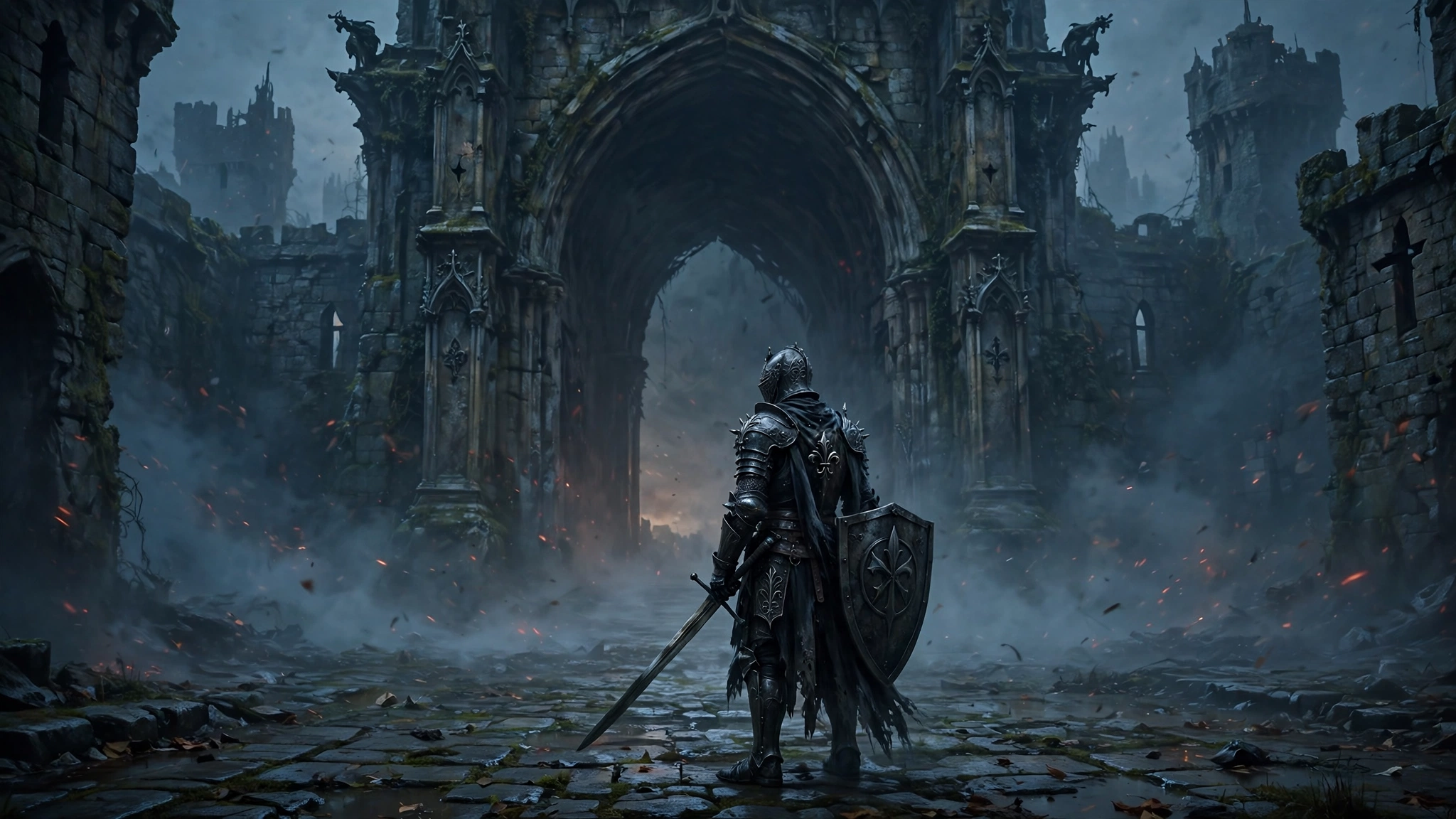
Demon’s Souls fans, the time has come. Bluepoint’s PS5 remake of FromSoftware’s brutal classic has lived only on PlayStation hardware since 2020, and PC players have waited six years for a way in. That wait is now over, at least for players who own the game. A new unofficial PC port called Regaliant runs Demon’s Souls Remake natively on Windows, with no emulator involved, and it already ships with the kind of PC feature set that official ports often take months to patch in.
Regaliant is the second unofficial PC port of a PS5 game to appear this month, following the first unofficial PC port of a PS5 game, and it is the bigger deal of the two. Demon’s Souls Remake is the game that launched the PS5, a full rebuild of the 2009 original that started the entire Souls genre. Until now, the only way to play it on PC was through a PS5 emulator. Regaliant takes a different road entirely, and that road is what makes this port so interesting.
What Regaliant Actually Is
Regaliant is an unofficial Windows PC port of Demon’s Souls Remake, built by developer SulphurS16 and released as free open source software under the GPL-3.0 license. The project went public on GitHub on November 23, 2026, and its first release is version 0.1.0.
The key point is that Regaliant is not an emulator. It does not use CPU emulation at all. Instead, the game’s own code runs directly on your PC’s processor, while the project replaces the PS5 system libraries with Windows versions. The game then renders its graphics through Vulkan. In plain terms, this is the actual PS5 game running on your PC, not a simulation of a PS5 running it.
That also means Regaliant contains no game files of its own. It ships no game data, no game code, and no keys, and it decrypts nothing. You need your own copy of Demon’s Souls Remake for PS5, product code PPSA01341, updated to version 1.07, with its executable and two libraries decrypted. The project is not affiliated with, endorsed, or sponsored by Sony Interactive Entertainment, Bluepoint Games, or FromSoftware.
The PC Features Are the Real Story
What makes Regaliant stand out is how complete its PC feature list already is. Most unofficial ports start bare and add options over time. This one arrives with a dedicated PC tab in the game’s own settings menu, and most settings take effect at once, with no restart needed.
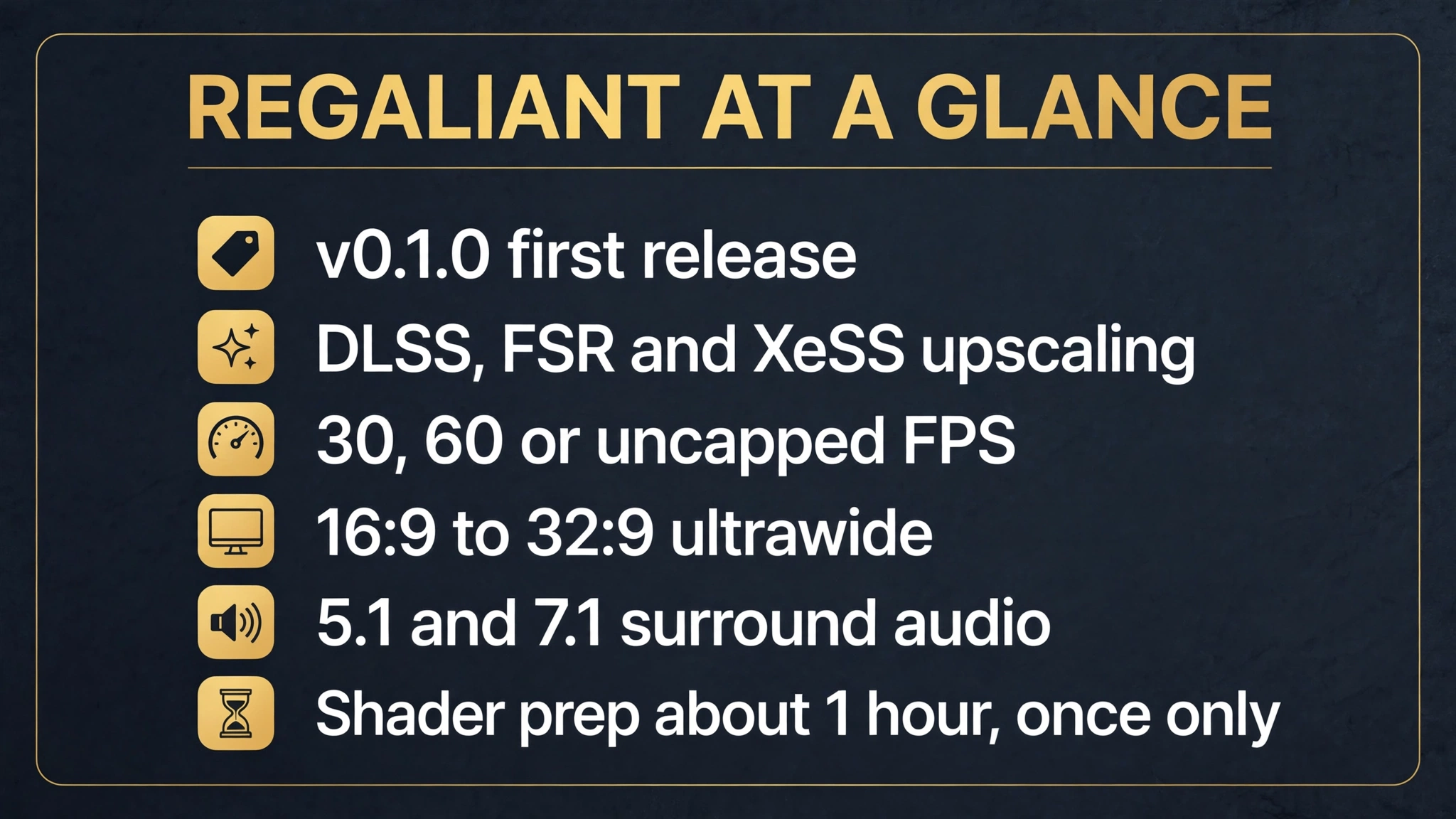
The headline features are the upscalers. Regaliant supports NVIDIA DLSS, AMD FSR, and Intel XeSS, and it feeds them the game’s own motion vectors and jitter data so they can rebuild the image properly. DLSS needs your own copy of NVIDIA’s DLSS file, but FSR and XeSS work out of the box. You can also tune the render scale, image sharpening, quality presets, geometry detail, shadow distance, texture filtering, bloom, and vignette effects.
Frame rate is fully unlocked in spirit. You can cap the game at 30 FPS, 60 FPS, or remove the limit entirely, and the game keeps its normal speed at any frame rate. Frame pacing stays even at any refresh rate, and G-SYNC and FreeSync are supported. Display options cover windowed, borderless, and exclusive fullscreen modes, with your choice of monitor, resolution, and refresh rate. Ultrawide players are covered too. The port supports 16:9, 16:10, 21:9, and 32:9 screens, and wider screens show more of the game world instead of stretching the image. HDR output works through the game’s own HDR mode.
| Feature | What Regaliant Offers |
|---|---|
| Upscaling | NVIDIA DLSS, AMD FSR, and Intel XeSS, fed by the game’s own motion vectors and jitter |
| Frame rate | 30 FPS, 60 FPS, or uncapped, with normal game speed at any frame rate |
| Frame pacing | Even pacing at any refresh rate, with G-SYNC and FreeSync support |
| Display modes | Windowed, borderless, or exclusive fullscreen, with monitor, resolution, and refresh rate choice |
| Aspect ratios | 16:9, 16:10, 21:9, and 32:9, with wider screens showing more of the world |
| HDR | HDR output through the game’s own HDR mode |
| Controls | Keyboard and mouse with raw input and full rebinding, Xbox and PlayStation controllers with native prompts, DualSense over USB or Bluetooth without Steam Input |
| Audio | 5.1 and 7.1 surround sound, 3D audio for headphones through Windows Sonic or Dolby Atmos for Headphones |
| Achievements | PS5 trophies converted to PC achievements, with pop-up alerts and a tracking list |
| Launcher | Game file checks, display setup before launch, save backup and restore, safe mode |
Controls deserve a special mention. PC players get full keyboard and mouse support with raw mouse input, custom key binds, and mouse use in menus, plus the correct key prompts for the setup you actually use. Every key can be changed in the game. Xbox controllers work and show Xbox button prompts, and a DualSense works directly over USB or Bluetooth, without Steam Input. That is a level of controller care that even some official PC ports skip.
Sound has received PC support as well. You can use 5.1 or 7.1 surround systems, and there is 3D audio for headphones, with support for Windows Sonic and Dolby Atmos for Headphones. Regaliant also turns the game’s trophies into PC achievements, complete with pop-up alerts and a list that lets you track your progress.
How It Runs Right Now
Performance is solid for a first release, but this is still an early project, so set your expectations accordingly. According to the project page, the game runs at 60 FPS or close to it in many places, and lower in the busiest areas, at about 40 to 55 FPS there on the main test PC, which uses a Ryzen 9 5900X and an RTX 4090. The developer notes that the processor’s single-core speed matters most, so a fast CPU counts for more here than a bigger GPU.
DSOGaming reports the same picture, with 60 FPS in many areas and busy areas running at around 40 to 55 FPS on that same Ryzen 9 5900X and RTX 4090 test system. Those are the developer’s own numbers, not independent benchmarks, and your mileage will vary with your hardware.
There is one catch before you play anything at all. Before the first launch, the game must prepare its shaders, and that takes about an hour on a fast PC, longer on others. It only needs to happen once. The launcher handles it by letting the game play itself in the background, hidden and silent, and after that the game should start right away. After a graphics driver update or a port update, the launcher only compiles the shaders again, without the self-play step.
What You Need to Play It
Getting started is straightforward, but the first requirement is the one that matters most. You must own a legitimate copy of Demon’s Souls Remake for PS5, updated to version 1.07. Regaliant is a port, not a copy of the game, and it will not work without your own files. The project page is clear on this point, and it asks users not to share game files, keys, or decrypted files in its issues or on its Discord server.
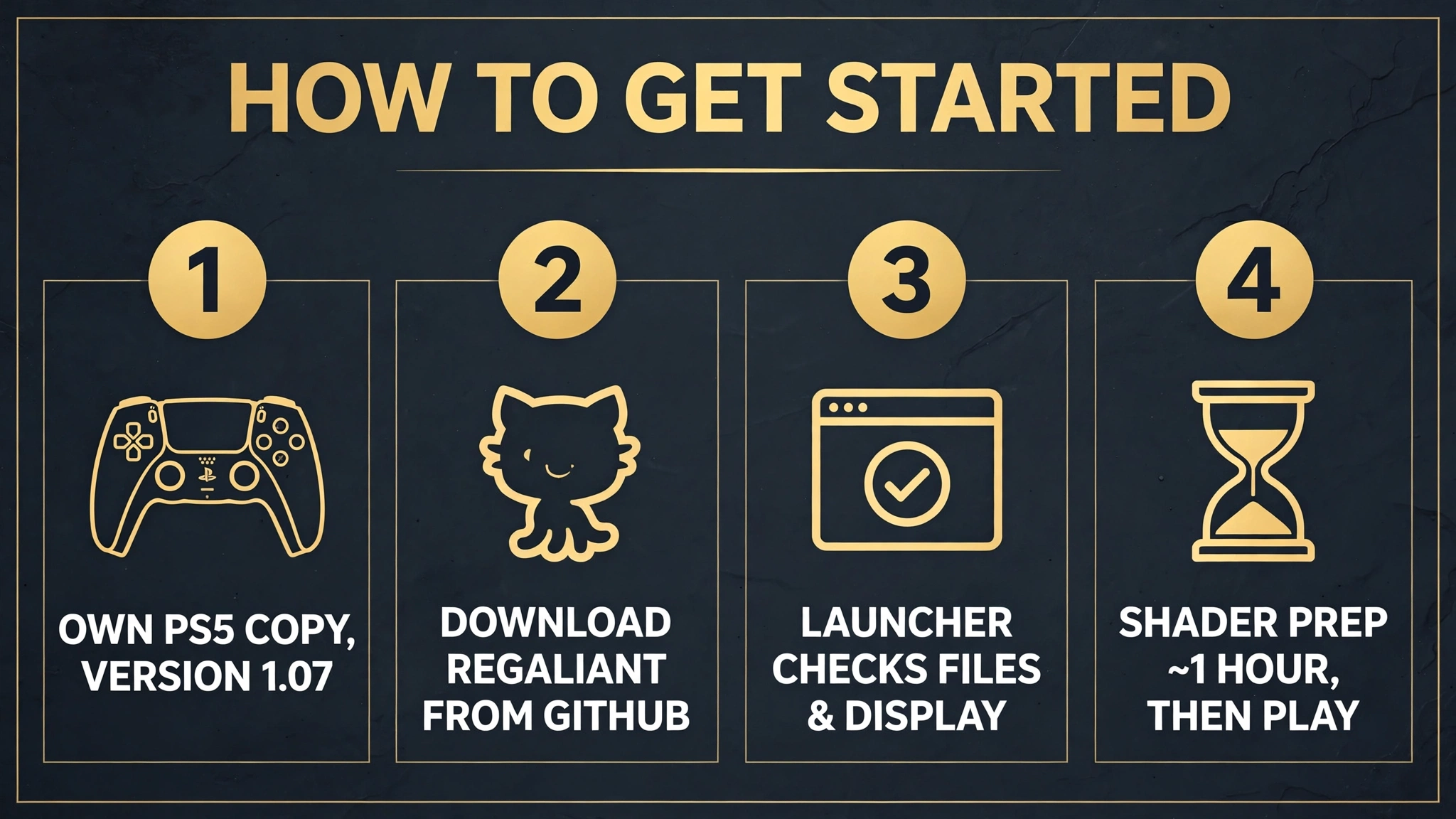
| What You Need | Details |
|---|---|
| The game | Your own copy of Demon’s Souls for PS5, product code PPSA01341, updated to version 1.07 |
| The port | Regaliant v0.1.0, free download from GitHub, GPL-3.0 open source |
| Game files | Executable and two libraries decrypted, following the project’s install guide; the port includes no game data and decrypts nothing |
| First launch | One-time shader preparation, about an hour on a fast PC, longer on slower systems |
| Online play | Not available yet; the game runs offline for now |
The port also comes with its own launcher, and it does more than start the game. It checks your game files, sets up your display before the game starts, and backs up your saves. You can restore your saves or use a safe mode if something goes wrong. If disk space is tight, the game can also live as a single .zar archive, at about two thirds of the folder’s size, read in place by the launcher.
You can download the port from the Regaliant project page on GitHub. DSOGaming first reported the release on November 23, 2026, and you can read their full report on DSOGaming.
What Is Still Missing
For all its polish, Regaliant is still an early project, and the developer is honest about that. A full playthrough has not been tested yet, so expect rough edges somewhere in Boletaria. Online play is not available, so the game is offline for now. That means no messages left by other players, no bloodstains, no co-op, and no invasions, which are a big part of what makes Demon’s Souls feel alive.
Hardware coverage is also narrow so far. The developer has not tested AMD or Intel graphics cards, RTX 50-series cards, HDR screens, or systems with 16GB of RAM. There are a few known quirks too. In a window on a 144 or 165 Hz screen, the game shows an even 48 or 55 FPS, while borderless or fullscreen mode with G-SYNC or FreeSync, or a 120 Hz screen, gives 60. Shaders that the preparation did not meet, such as rare effects and spells, still compile on first sight, and a level’s first arrival can pause briefly.
None of that is unusual for a version 0.1.0 release, and the known issues list is public on the project page. If you try it, go in knowing it is a work in progress, and keep your saves backed up, which the launcher makes easy.
What Comes Next
The roadmap is ambitious, and the developer lists the goals roughly in order, while stressing that they are aims, not promises or dates. First comes a steady 60 FPS everywhere, including the busiest places, and then higher frame rates for high-refresh screens. Next is shorter shader preparation, and eventually none at all, with shaders compiled in the background while you play, without stutter.
After that comes mod support, through a mods folder whose files the game loads in place of its own, so mods never change your game files. The biggest goal, and the furthest off, is online play, with messages, bloodstains, co-op, and invasions running through a community server. If that last one lands, Regaliant stops being a way to play Demon’s Souls on PC and becomes the full Demon’s Souls experience on PC.
This release also fits a wider wave. Unofficial ports have become one of the most active corners of PC gaming this year, from the Metroid Prime 4: Beyond unofficial PC port to the Bloodborne path tracing mod on PC. Demon’s Souls Remake joining that list matters because it was one of the last major PS5 exclusives with no PC path at all, and now it has one, built in the open, for free.
All in All
All in all, this is a huge moment for PC Souls fans. A native PC port of Demon’s Souls Remake, with DLSS, FSR, and XeSS, ultrawide support, unlocked frame rates, proper keyboard and mouse controls, and a launcher that handles the hard parts, is far more than anyone had a right to expect from a first release. Yes, it is early, offline only, and untested on AMD and Intel hardware, and the one-hour shader prep is a real ask. But the foundation is serious, the project is open source, and the roadmap points exactly where it should. Kudos to SulphurS16 for bringing Boletaria to PC. If you own the PS5 game, this is the port you have been waiting for, and it is only going to get better from here.