Rainbow Six Vegas Is Reportedly Coming Back After Nearly 20 Years
Rainbow Six Vegas is reportedly coming back. Nearly two decades after the last entry, Ubisoft Montreal has greenlit a third game in the Vegas sub-series, according to a new report from Insider Gaming’s Tom Henderson. If the report holds, one of the most beloved tactical shooters of the Xbox 360 era is finally getting a revival.
This is still a report, not an official announcement. Ubisoft has not confirmed the game, shown a trailer, or named a release window. But Henderson is one of the most reliable insiders in the industry, and the report lines up with Ubisoft’s recent push to revive its classic franchises. Here is everything we know so far, and what a new Vegas game could mean for PC players.
What Tom Henderson Is Reporting
According to Henderson, Ubisoft Montreal has spun off three new projects, and one of them is a new Tom Clancy’s Rainbow Six Vegas game. The report was published by Insider Gaming and covered by Wccftech on November 14, 2026.
Key points from the report:
- Ubisoft Montreal has greenlit three new projects in total.
- One of those projects is a return of the Rainbow Six Vegas sub-series, effectively a third entry.
- No title, platforms, release date, or gameplay details have been reported yet.
- It may be several years before Ubisoft shares any concrete details.
The timing is interesting. Ubisoft already announced a single-player, turn-based Rainbow Six spin-off called Rainbow Six Tactics at Gamescom 2026. A Vegas revival would be a very different kind of return: a full first-person tactical shooter in the classic mould, rather than an experimental spin-off.
Why Vegas Mattered: What the 2006 Original Did Differently
The original Rainbow Six Vegas launched in 2006 for PC, Xbox 360, and PlayStation 3. It was a major reinvention of a franchise that had started life as a PC-only tactical shooter, and it borrowed ideas from the most popular shooters of its time without losing its tactical identity.
Here is what made it stand out:
- Regenerating health and unlimited squad revives. A sharp break from the one-shot deaths of classic Rainbow Six, and a big reason the game felt approachable without going fully arcade.
- A seamless first-to-third-person cover system. The camera slid smoothly from first person to a third-person over-the-shoulder view when you took cover, then back again when you moved out. It let players peek around corners, survey rooms safely, and blind-fire over cover.
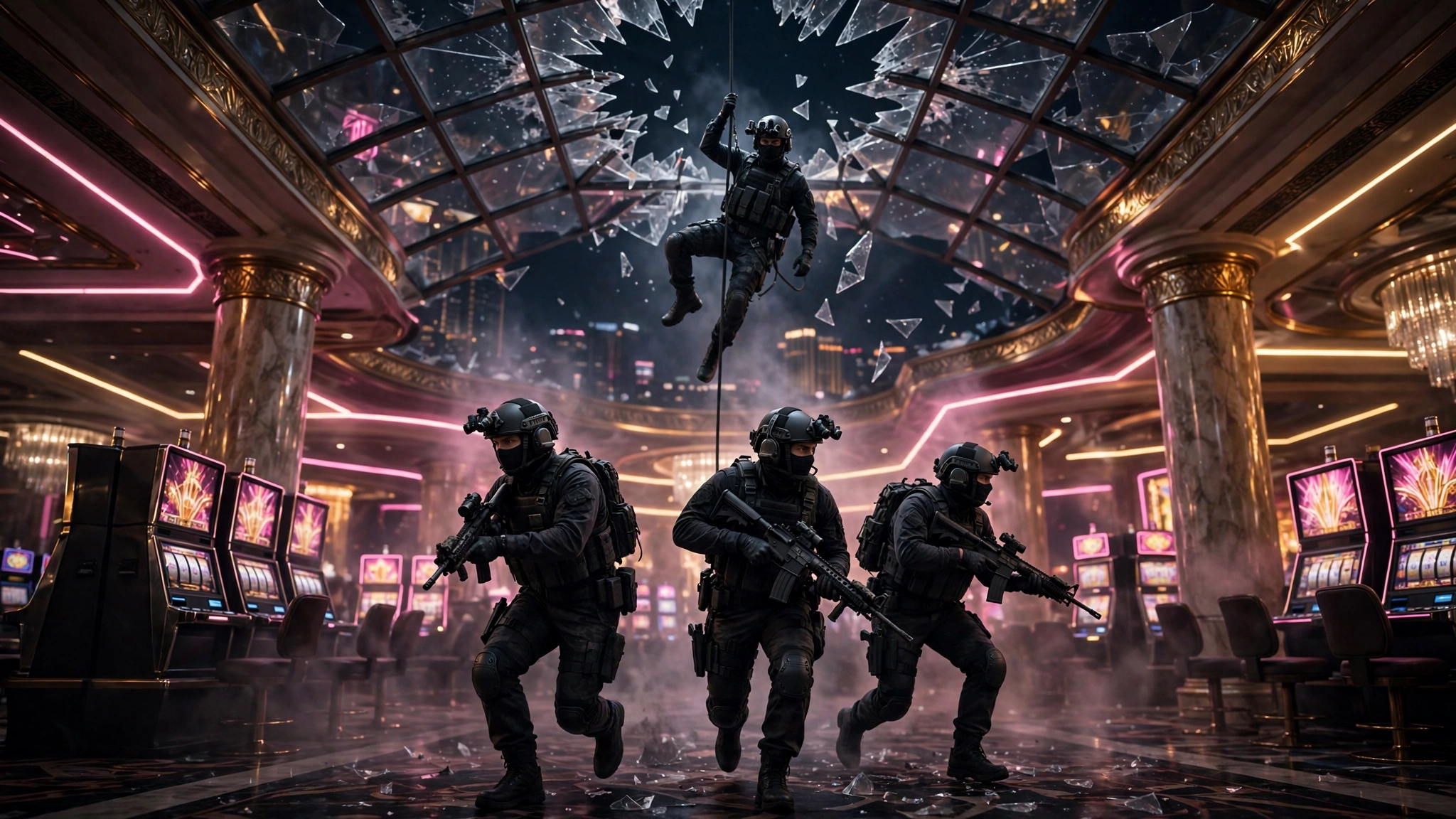
- Vertical combat spaces. Vegas levels made heavy use of height. Players and AI squadmates could rappel down casino facades, elevator shafts, and glass skylights, and even flip upside down into an inverted rappel to breach upper-story windows and clear rooms from unexpected angles.
- Persistent progression across modes. Unlocks carried across the campaign and multiplayer, which kept players coming back long after the story was done.
- The Las Vegas setting itself. Casinos, hotels, and neon streets gave the game a visual identity that stood apart from the grey military bases and nondescript warehouses of most shooters at the time.
The game was a major success, and a sequel followed in 2008. Rainbow Six Vegas 2 was well received, but it was widely seen as too similar to its predecessor, and the sub-series went quiet after that.
What Happened After Vegas 2
When Rainbow Six returned in 2015, it went in an entirely different direction. Rainbow Six Siege dropped the single-player campaign focus and became a competitive multiplayer shooter built around destructible environments and operator gadgets. It worked: Siege became one of Ubisoft’s biggest live-service successes and is still going strong more than a decade later.
But Siege left a gap. Players who loved the slower, squad-based, story-driven side of Rainbow Six never really got a modern replacement. A Vegas revival could fill exactly that gap, especially if it brings back the campaign structure and the cover and verticality systems that defined the originals.
That is the hope, at least. A modern Vegas game would also have to answer a harder question: how do you keep the tactical depth that made the series special while competing with the pace and presentation of today’s shooters? Ubisoft has not said anything yet, so for now the answer is pure speculation.
Why Ubisoft Is Reviving Its Classics Now
The Vegas report does not exist in a vacuum. Ubisoft has been leaning on its back catalogue more and more, and the reasons are easy to see. Siege is still a strong earner more than a decade after launch, but it serves one audience: competitive multiplayer players. The players who grew up with the story-driven Rainbow Six games have had nothing new aimed at them since Vegas 2 in 2008. A revival gives Ubisoft a way to serve that audience without building a brand-new franchise from scratch.
There is also the name itself. Vegas is one of the most fondly remembered sub-series in the whole Rainbow Six franchise, and its setting does half the marketing work. Casinos, neon streets, and glass towers are instantly recognizable, and they look very different from the grey military bases that fill most modern shooters. For a publisher trying to stand out in a crowded shooter market, that visual identity is worth a lot.
The other two greenlit projects in the report are still unknown, which is worth remembering. Three projects from one studio suggests Ubisoft Montreal is spreading its bets: a turn-based spin-off in Tactics, a possible Vegas revival, and something else entirely. That spread makes sense for a studio that has to keep its biggest franchise alive while also trying new things.
What This Means for PC Players
Rainbow Six started on PC, and the Vegas games were at their best there. A new entry would almost certainly launch on PC alongside consoles, and the tactical shooter audience on PC is as strong as it has ever been.
A few things PC players should watch for:
- A real campaign. The originals were built around a proper story mode with squad commands. If the new game follows that template, it would be a genuine alternative to the multiplayer-only direction Siege took.
- Modern tech, classic systems. The cover system and vertical level design were ahead of their time in 2006. With today’s engines, rappelling, breaching, and room clearing could be far more dynamic.
- How it sits next to Rainbow Six Tactics. Ubisoft is already experimenting with the franchise through the turn-based Tactics spin-off. A Vegas game would show whether the publisher wants the classic first-person formula back as well, or whether Tactics is the only single-player Rainbow Six on the way.
For now, the smart move is to treat this as an early report. Henderson’s track record gives it weight, but greenlit projects can change shape, get delayed, or get cancelled long before they are announced.
What a Modern Vegas Game Needs to Get Right
If the revival is real, the hardest part will not be the setting or the name. It will be the balance. The originals worked because they sat between two worlds: slower and more deliberate than a run-and-gun shooter, but faster and more forgiving than the punishing one-shot realism of classic Rainbow Six. A modern version has to find that same middle ground, and it has to do it for players who now expect the polish and presentation of a 2020s blockbuster.
Three things matter most. First, the squad has to feel alive. The originals were built around AI teammates you could actually command, and that squad play was the heart of the campaign. A modern Vegas without proper squad commands would be missing the point. Second, the cover and verticality systems have to come back in full, not as a gimmick. Rappelling down a casino facade and breaching through a skylight was the signature move of the series, and it is the thing no other shooter does quite the same way. Third, the game needs to respect the PC audience it came from: proper mouse and keyboard controls, and a campaign that is built for players who want to plan a room entry, not just sprint through one.
None of this is confirmed, and none of it will be for a long time. The report itself says it may be years before Ubisoft shares concrete details. But the wish list writes itself, because the originals left such a clear template. If Ubisoft follows it, a Vegas revival could be the single-player Rainbow Six game fans have been waiting nearly twenty years for.
What We Still Do Not Know
- Release date: nothing reported. Given the report says it may be years before concrete details emerge, do not expect this soon.
- Platforms: not confirmed, though a PC release is highly likely given the series’ history.
- Setting and story: whether it returns to Las Vegas or takes the sub-series somewhere new is unknown.
- Development status: the project is described as greenlit, which is an early stage, not a game nearing release.
- Official confirmation: Ubisoft has said nothing. Until it does, this stays in the report category.
We will update this story as soon as Ubisoft confirms or comments on the report. For now, fans of the originals can at least take comfort in one thing: after nearly 20 years, Vegas is back on the table.
If you are tracking the big comebacks in PC gaming, our Wolfenstein 3 report covers another classic shooter franchise returning, and our upcoming PC games 2026-2027 list rounds up the major releases on the horizon. For another long-awaited PC release, see our GTA VI PC release date guide.
Source: Wccftech, reporting on Tom Henderson at Insider Gaming.