Silent Hill 1 Native PC Port Brings Ray Tracing, HDR and Mod Support to the 1999 Classic
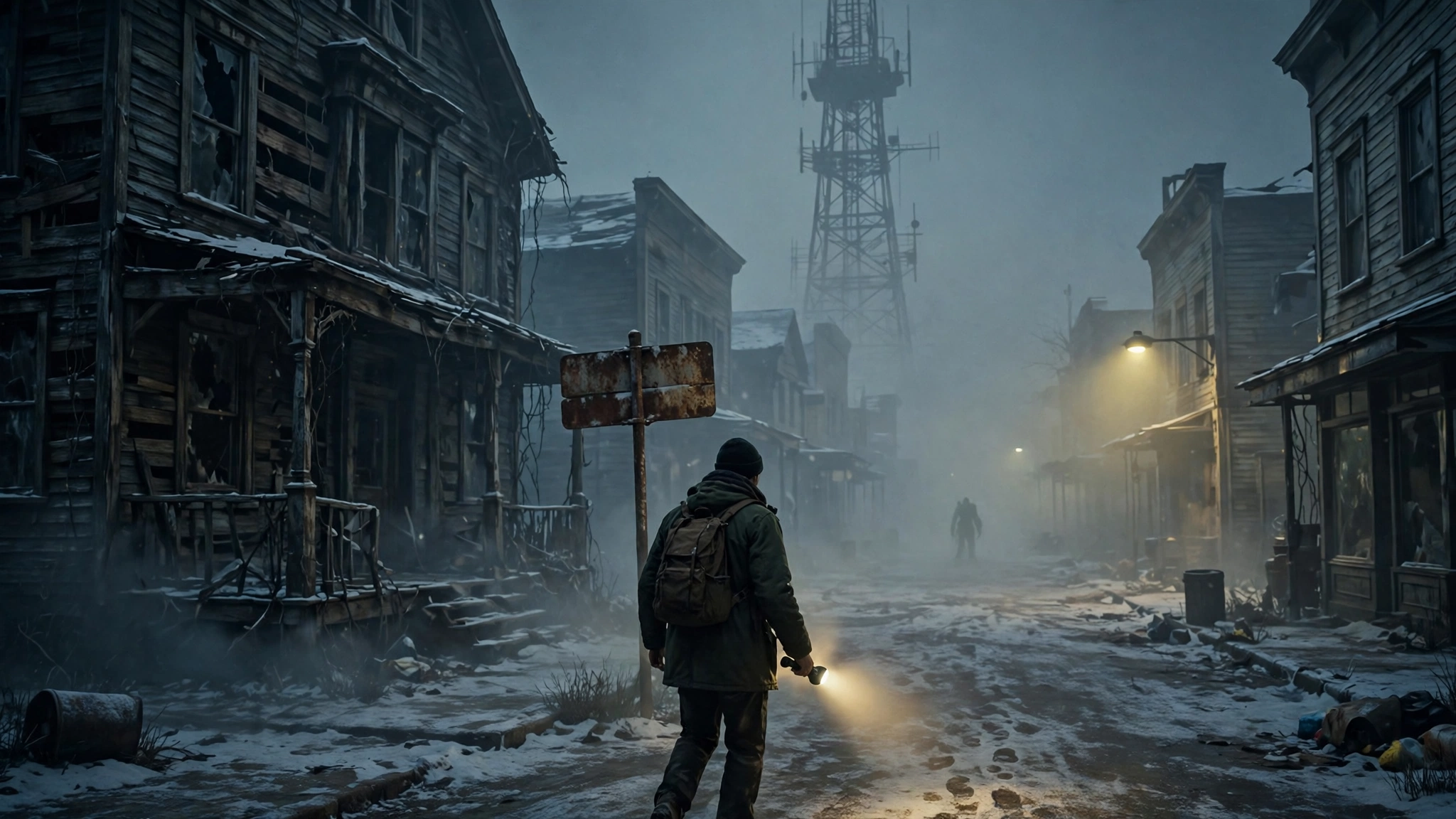
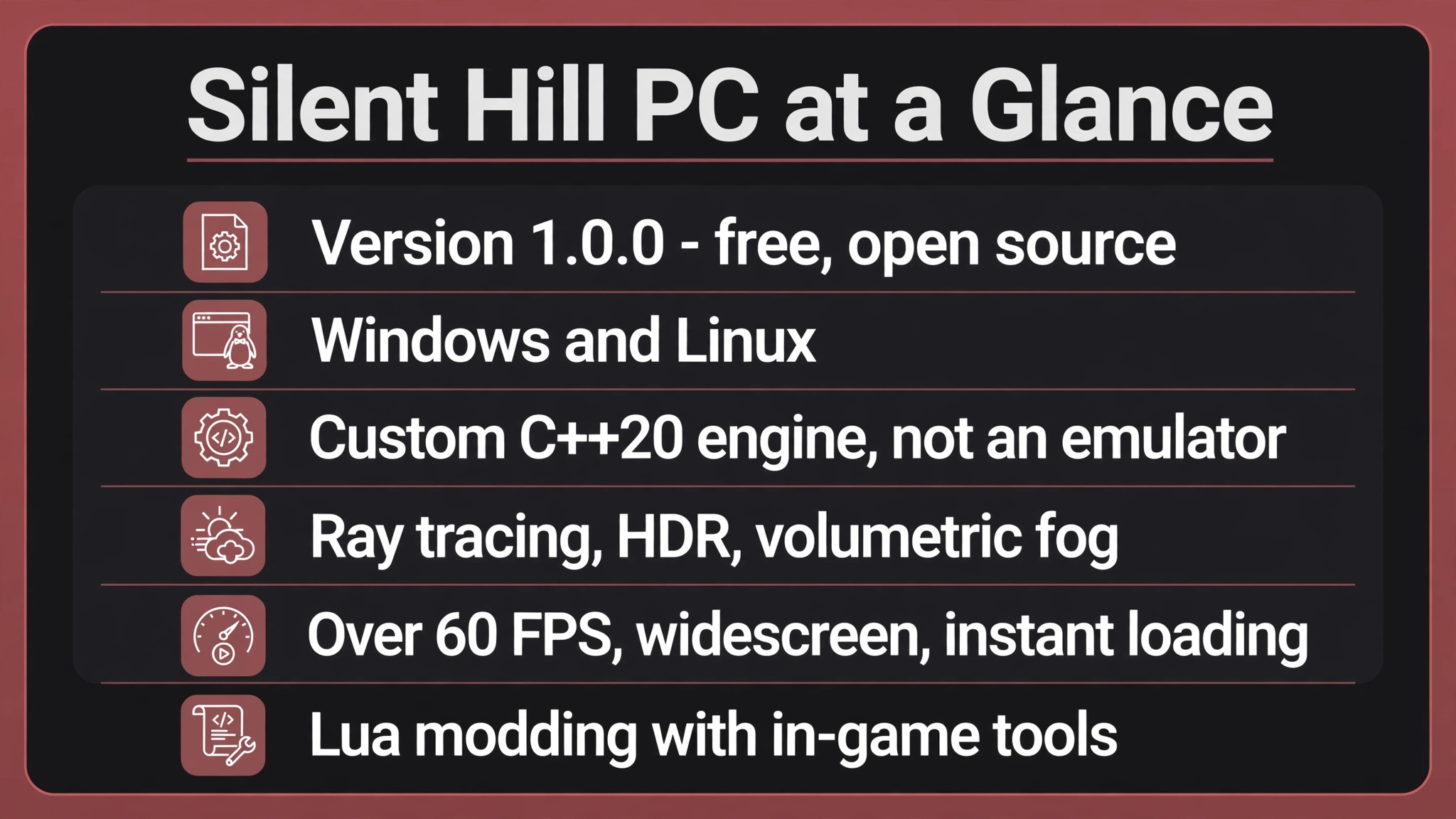
Silent Hill fans, the fog is back, and this time it runs natively on PC. More than 27 years after Konami’s survival horror classic debuted on the original PlayStation, a new open-source project called Silent Hill PC has rebuilt the 1999 game on a custom engine with ray tracing, HDR, AI texture upscaling and full mod support. Version 1.0.0 is out now, free for Windows and Linux, and it needs no emulator at all.
The project was announced on Reddit on November 24, 2026, and it lands at a moment when community preservation of horror classics is moving fast. Fans recently got the native PC port of P.T., and Bloober Team’s official Silent Hill remake is reportedly targeting a 2027 release. Silent Hill PC sits between those two poles: a fan-built way to play the original today, with modern rendering doing the heavy lifting.
What Silent Hill PC Actually Is
Silent Hill PC is an unofficial native port of the original Silent Hill, built on a custom engine written in C++20. The developer announced the project on Reddit, with version 1.0.0 available now for Windows and Linux as a free download.
The key point is that this is not an emulator. The engine recreates the original game’s behavior using the community-led Silent Hill decompilation project as a reference, rather than directly compiling the game’s original code or relying on conventional PlayStation emulation. In plain terms, the game logic runs natively on your PC, through an engine built for the job.
The project is open source under the GPL-3.0-or-later license, with the source code and precompiled binaries available on GitHub. That matters for longevity: even if development slows down, anyone can pick the code up, fix bugs, and keep the port alive. The developer is also open about how the port was built, acknowledging extensive use of generative AI tools, including GLM 5.2 and Claude Opus 5.5, during development.
It is still early, though. Despite reaching version 1.0.0, the project remains under active development, and the developer is especially interested in feedback from Windows users, since development takes place primarily on Linux.
The Graphics Upgrades Are the Real Story
The headline feature set is unusually complete for a first release. The engine supports three renderers, OpenGL, SDL3 GPU and a dedicated Vulkan renderer, and the Vulkan path unlocks the advanced rendering features that make this port worth talking about.
| Feature | What It Does in Silent Hill PC |
|---|---|
| Ray tracing | Ray-traced shadows, reflections and indirect lighting through the Vulkan renderer |
| HDR output | High dynamic range output for supported displays |
| Volumetric fog | Thick, light-reactive fog that keeps the town’s signature atmosphere |
| Temporal anti-aliasing and upscaling | Smoother edges and a cleaner image at higher resolutions |
| Ambient occlusion and dynamic lighting | Deeper shadows and lights that react to the scene |
| AI texture upscaling | Experimental Real-ESRGAN upscaling up to 4x, with the developer recommending 2x |
| Model smoothing | Experimental smoothing for the original low-poly character and environment models |
The AI texture upscaling deserves a note of caution. It is labeled experimental, and the developer recommends sticking with 2x enlargement rather than pushing Real-ESRGAN to its 4x maximum. That is sensible advice: aggressive AI upscaling on 1999 textures can smear the very detail that makes the original art direction work.
Players can choose between several graphical presets, ranging from a faithful recreation of the original PlayStation presentation to Ultra RTX. That range is the smartest design decision in the port. Silent Hill’s horror lives in its fog, its darkness and its oppressive atmosphere, and the developer has said the intent is to preserve those qualities even when modern graphical enhancements are switched on. A ray-traced Silent Hill that loses its fog would be a worse Silent Hill.
Beyond the rendering, the port adds the quality-of-life features PC players expect: widescreen support, virtually instantaneous loading, configurable controls, and support for frame rates exceeding 60 FPS, including during cutscenes. The original game was locked to the limits of 1999 hardware. This version is not.
Modding Is Built Into the Engine
The graphics will get the headlines, but the modding support is what could give this port a long life. Much of the game’s functionality is implemented through external data files and Lua scripts, which means modders can introduce new weapons, characters, items and scripted events without modifying the underlying engine.
The project even ships its own in-game modding tools, including a free camera, a map inspector, a Lua editor and asset viewers. That is a serious toolkit for a version 1.0.0 release, and it lowers the barrier for the community to build on the port instead of just playing it. If the modding scene takes hold, Silent Hill PC could become a platform for new Silent Hill content, not just a way to replay the original in higher fidelity.
This is the same pattern that has kept other community ports alive for years. The native PC port of Shadow the Hedgehog and the unofficial PC port of Zelda Ocarina of Time both grew because their communities could build on open, moddable foundations. Silent Hill PC is starting from the same place.
What You Need to Play It
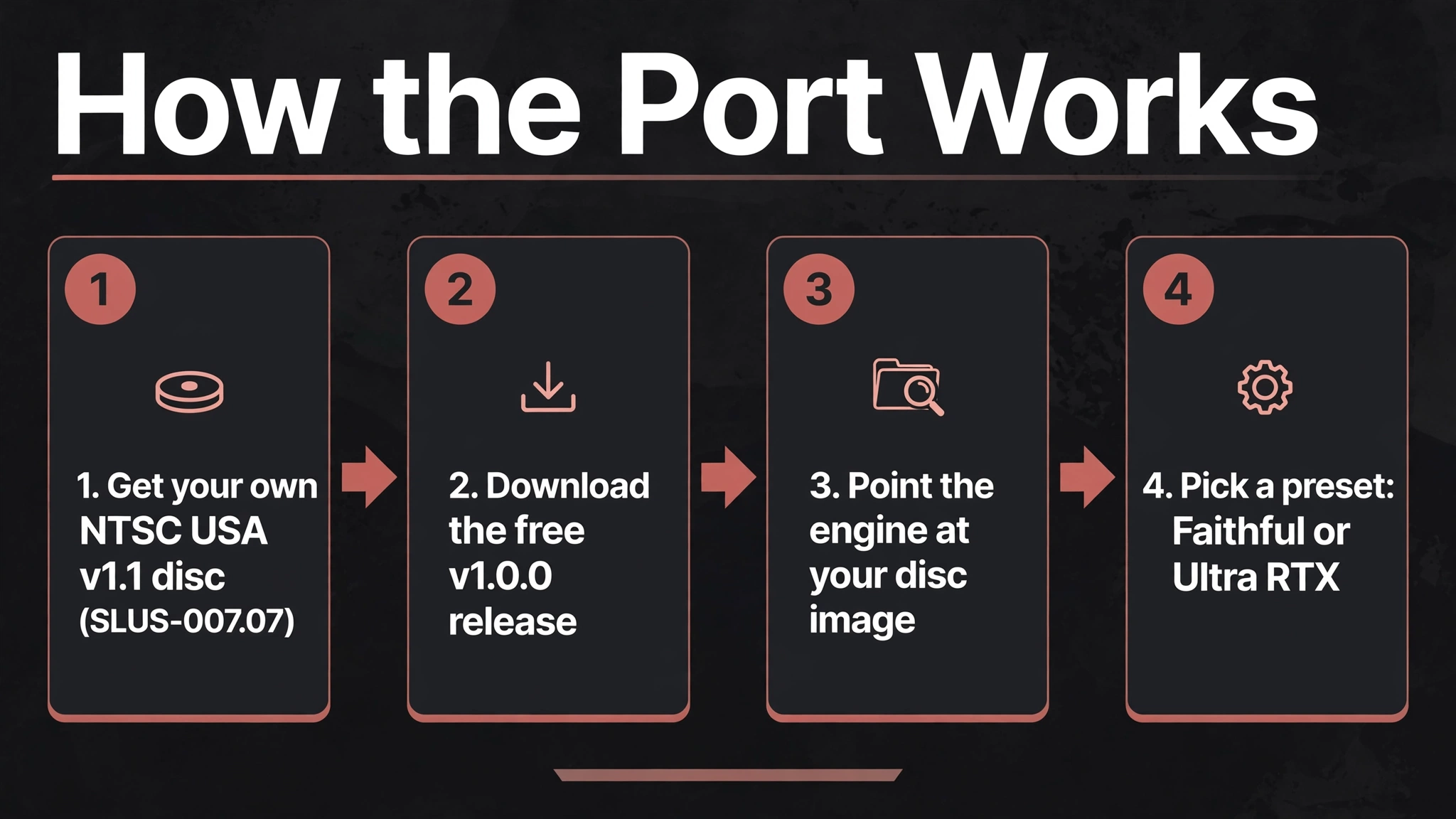
Silent Hill PC ships with no game data of its own, so you need to supply the original game yourself. Players must provide their own legally obtained NTSC USA v1.1 disc image, product code SLUS-007.07, from which the engine imports the necessary game assets. Other regional versions are not currently supported, so PAL and Japanese copies will not work with this release.
Getting started is straightforward:
- Get your disc image ready. You need your own legally obtained copy of the North American PlayStation release, NTSC USA v1.1 (SLUS-007.07).
- Download the release. Version 1.0.0 is free, with precompiled binaries for Windows and Linux on the project’s GitHub releases page, and the full source code under GPL-3.0-or-later.
- Point the engine at your disc image. The engine imports the assets it needs from your image and leaves the rest to the new renderer.
- Pick a preset. Start with the faithful preset to see the original presentation, then step up toward Ultra RTX to see what the modern renderer adds.
One practical note: development happens primarily on Linux, so Windows players may hit rough edges the developer has not seen yet. That is exactly the feedback the developer is asking for, and it is worth remembering that this is a version 1.0.0 community project, not a commercial release with a support desk.
Not the Only Silent Hill PC Project
Silent Hill PC should not be confused with SH1PC, another existing native port of the original game. The two projects take different technical paths. SH1PC builds upon the original game’s decompiled source code and uses the PsyCross compatibility layer, while Silent Hill PC recreates the game’s behavior in a custom C++20 engine that uses the decompilation project only as a reference.
That distinction matters less to players than to developers, but it is good news for fans either way: two independent teams are now working on bringing the 1999 classic to modern PCs, and competition between open-source projects tends to push both forward. If one project stalls, the other keeps going.
The wider Silent Hill scene is busy too. The Silent Hill 3 fan remaster with modernized path tracing showed how far community work on this series can go, and the P.T. port proved there is real appetite for playing these games natively on PC. Silent Hill PC is the latest entry in that wave, and it arrives with the most complete feature list of the three.
Why This Port Matters
Silent Hill has never had an official PC release of the original game. For more than 27 years, the only way to play it on a computer was through PlayStation emulation, with all the quirks that brings. A native port with a modern renderer changes that equation completely: no emulator configuration, no BIOS files, no accuracy trade-offs, just the game running on your hardware with settings that belong on a PC.
It also matters for preservation. The original PlayStation discs are aging, and the hardware that plays them is not getting younger. Open-source ports built on clean-room-style reimplementation are how games like this survive past the lifespan of their original platform. The GPL-3.0 license means this port cannot quietly disappear if one developer moves on.
None of this replaces the official remake. Bloober Team’s Silent Hill remake is reportedly targeting a 2027 release, and it will be a full modern reimagining rather than a faithful port. But remakes and ports serve different purposes. The remake will show what Silent Hill can be with a modern budget. Silent Hill PC shows what the original already was, running the way it deserves to run on modern hardware.
All in all, this is the most exciting community release for Silent Hill fans since the P.T. port. A free, open-source, native PC version of the 1999 original, with ray tracing, HDR, AI upscaling, widescreen, high frame rates and Lua modding built in, is a remarkable thing to get for nothing. If you own the original disc, there is very little reason not to try it. Just keep the fog on.
News Source: Wccftech, via Reddit. Project source code: Silent Hill PC on GitHub.