Samsung Odyssey G6 G60H Brings a 1100 Hz Mode to a 27 Inch QHD Gaming Monitor
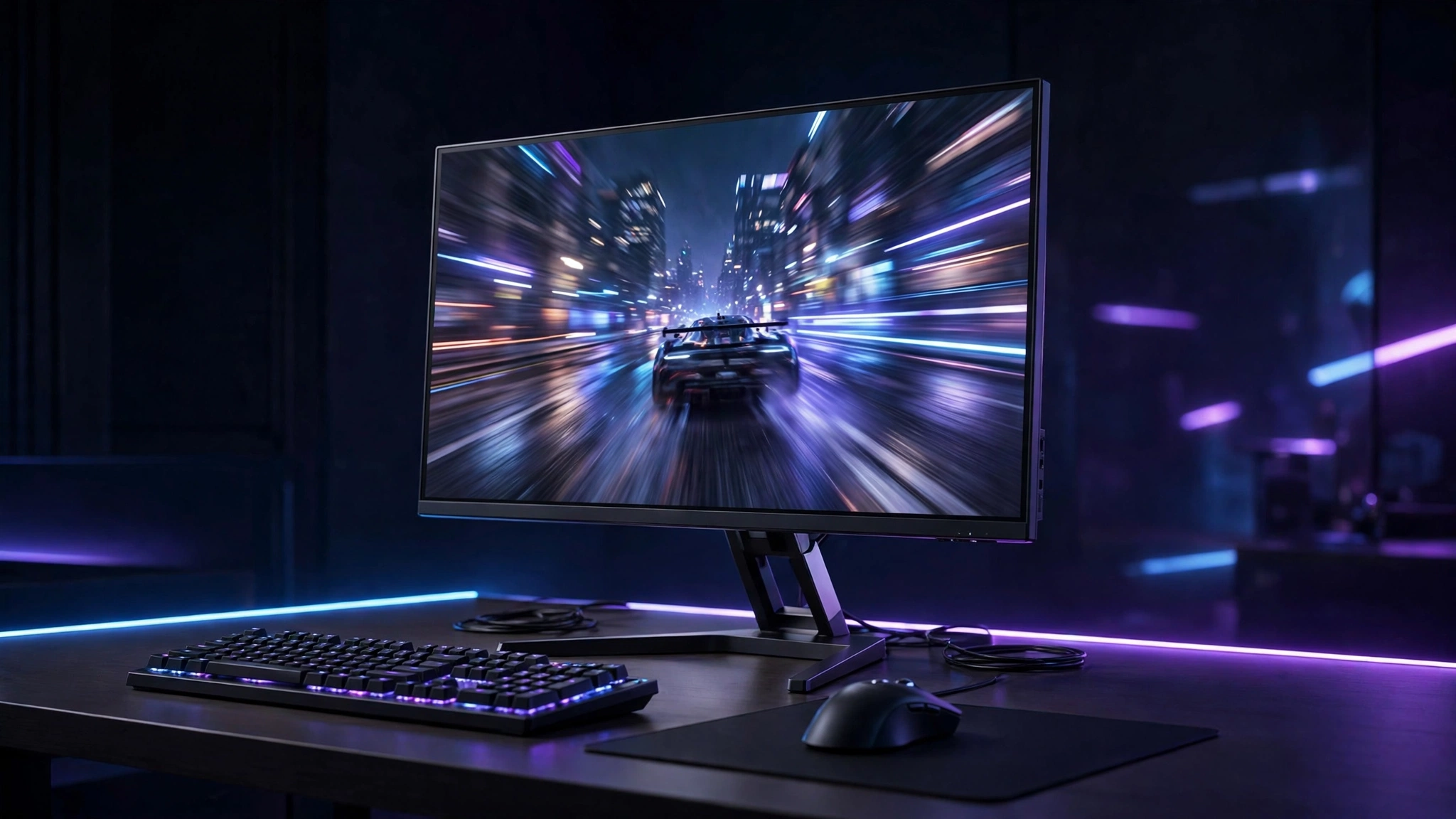
Samsung clearly thinks the answer to how fast a gaming monitor needs to be is faster than anything you can buy today. The company has put a final price and a launch window on its 27-inch Odyssey G6 G60H, a dual-mode gaming monitor that runs at up to 1,100 Hz. That number is not a typo. At HD resolution the panel refreshes 1,100 times per second, and at QHD it still manages 600 Hz. For competitive players who live and die by motion clarity, this is the most extreme refresh rate ever put on a mainstream gaming display.
We have seen 500 Hz and 600 Hz panels before, but 1,100 Hz is a different league entirely. The real question for PC gamers is not whether the panel can do it, because Samsung says it can. The question is whether any game and graphics card combination can feed it 1,100 frames per second, and whether the trade-offs are worth the $899.99 US price. Here is everything Samsung has confirmed, plus the fine print that matters before you pre-order.
Dual Mode Explained: Two Monitors in One Panel
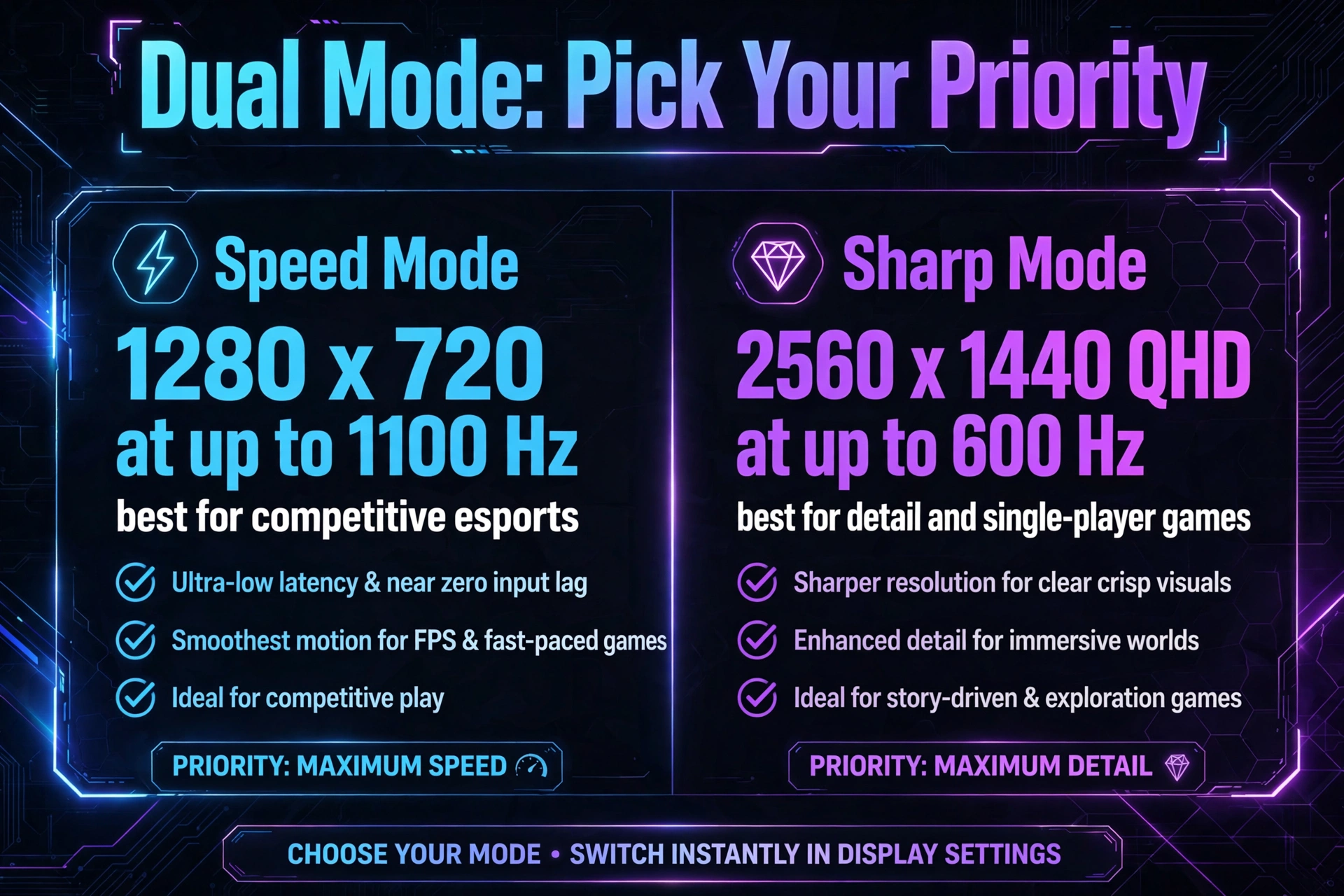
The G60H is a dual-mode monitor, which means it offers two distinct operating modes and you pick the one that fits what you are playing. Samsung calls the technology Dual Mode, and it works like this:
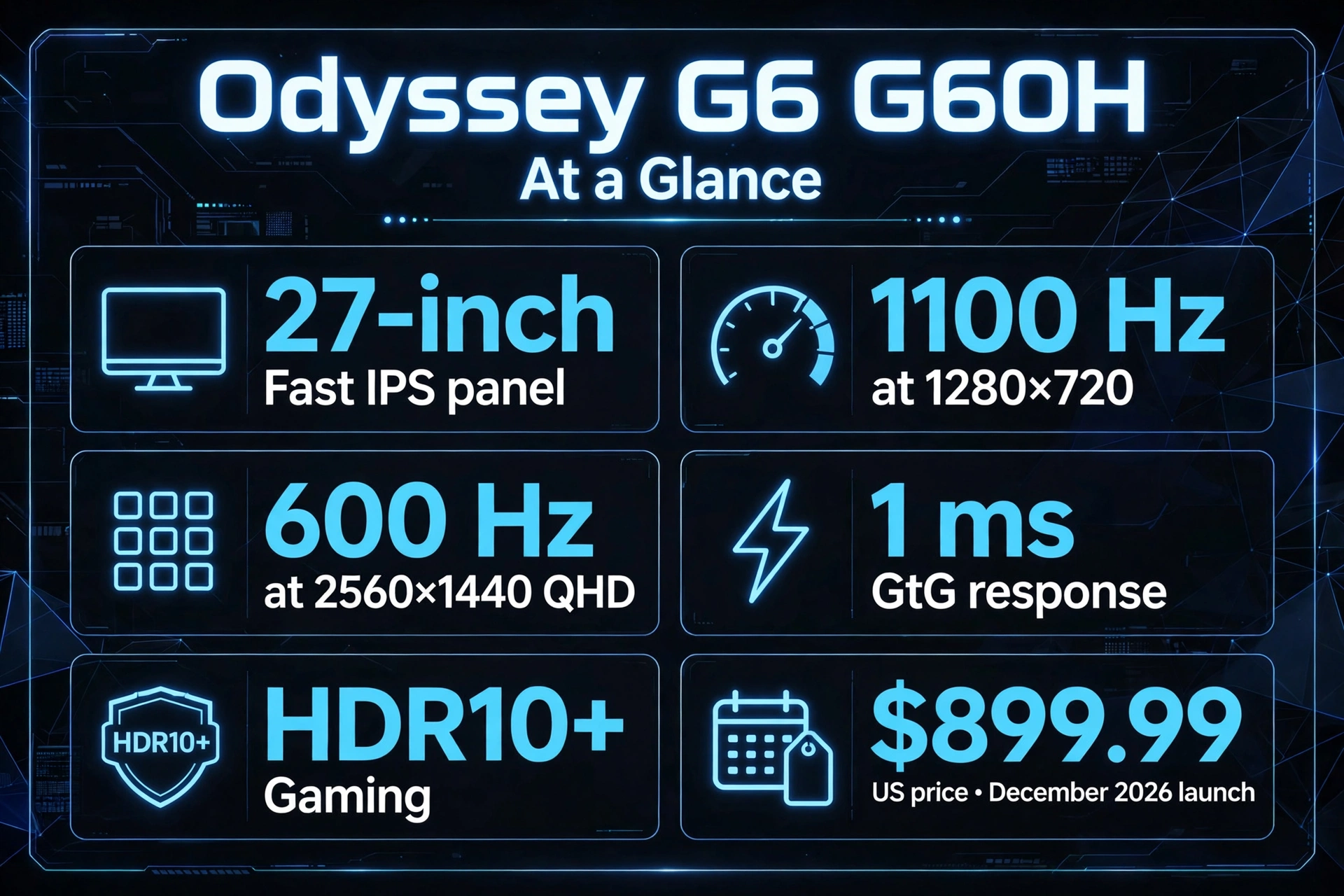
- Speed Mode: 1280 x 720 resolution at up to 1,100 Hz. This is the mode for competitive esports titles where every millisecond of motion clarity counts.
- Sharp Mode: 2560 x 1440 QHD resolution at up to 600 Hz. This is the mode for story-driven games, open worlds, and anything where detail matters more than raw speed.
You switch between the two in the display settings, so the same monitor serves both purposes without a second screen on your desk. The panel itself is a 27-inch Fast IPS display with a stated 1 ms grey-to-grey response time, which keeps motion blur low in either mode. Samsung also includes its Odyssey Clear Motion blur-reduction feature, HDR10+ Gaming for brighter highlights and deeper shadows, and Black Equalizer to preserve detail in dark scenes.
Odyssey G6 G60H Full Specifications
Samsung first showed the G60H in December 2025 with a slightly lower 1,040 Hz ceiling. The final production version pushes that to 1,100 Hz. The full specification list, taken from Samsung’s own listing via The FPS Review and Guru3D, is below.
| Specification | Samsung Odyssey G6 G60H |
|---|---|
| Screen size | 27-inch, flat, 16:9 |
| Panel type | Fast IPS |
| Dual Mode 1 | 1280 x 720 at up to 1,100 Hz |
| Dual Mode 2 | 2560 x 1440 QHD at up to 600 Hz |
| Response time | 1 ms GtG |
| Brightness | 400 cd/m2 typical, 450 cd/m2 peak |
| Contrast ratio | 1,000:1 |
| HDR | HDR10, HDR10+ Gaming |
| Colour | Max 1 billion colours, 99% sRGB coverage |
| Adaptive sync | NVIDIA G-Sync Compatible, AMD FreeSync Premium |
| Connectivity | 1x DisplayPort 2.1, 2x HDMI 2.1, 1x USB-B upstream, 2x USB-A 3.2 Gen1 |
| Stand | Height, tilt, swivel and pivot adjustment, Auto Source Switch+ |
| US price | $899.99 |
| US launch | December 2026 |
The connectivity is modern throughout. DisplayPort 2.1 is the port you want for the highest refresh modes, and the two HDMI 2.1 ports cover consoles and a second PC. The stand adjusts in every direction, which matters at this price, and Auto Source Switch+ detects a newly connected input automatically.
Price and Launch Date
Samsung has set the US price at $899.99, with the monitor reaching US retailers in December 2026. That is the announced price as of November 24, 2026. Pre-orders are already live on Amazon, where The FPS Review spotted a listing price of $856.32 when it checked on November 23, 2026, with a release date of November 24. The Amazon listing price may move, so treat the $899.99 figure as the official US price and check the live listing before you buy.
For an IPS gaming display, $899.99 is a high price. Samsung is clearly betting that the 1,100 Hz headline and the 600 Hz QHD mode are worth a premium over the 240 Hz and 360 Hz monitors that currently dominate the high-refresh market. If you are shopping in this price range, our best gaming monitors by budget guide is a useful cross-check for what the same money buys elsewhere.
What Hardware You Need to Use 1100 Hz
Here is the honest part. A 1,100 Hz panel is a maximum capability, not a promise that your games will run at 1,100 frames per second. Guru3D makes the same point in its coverage: the advertised rate describes what the panel can display, not what any given game or graphics card will render. Almost no current game and GPU combination produces 1,100 unique frames per second, even at 720p, and only a handful of lightweight competitive titles such as Counter-Strike 2 and Valorant come close to those frame rates on top-end hardware.
That does not make the monitor useless. Frame generation technology is the realistic path to the highest refresh rates, and it keeps getting better. NVIDIA’s latest DLSS 4.5 and Reflex updates add multi frame generation to more games, while AMD owners can unlock AFMF 3 frame generation on RDNA 3 and RDNA 4 cards. Pairing one of those technologies with a fast GPU is how most buyers will actually approach the 600 Hz QHD mode, let alone 1,100 Hz.
What If You Cannot Reach 1100 FPS
If your hardware cannot push anywhere near 1,100 FPS, the monitor still works as a superb 600 Hz QHD display, which is already faster than almost every monitor on the market today. The QHD mode is arguably the more relevant figure for most buyers, because it pairs high refresh with the sharp detail you actually notice in daily play. The 1,100 Hz mode is there for the day your hardware catches up, and for competitive players who run lightweight titles at minimum settings today.
The Fine Print Worth Knowing
Samsung’s own footnotes carry three limitations that buyers should read before ordering:
- FreeSync Premium does not support the 1,100 Hz mode. AMD card owners can use FreeSync Premium in the lower refresh modes, but the headline 1,100 Hz mode is outside its supported range.
- macOS does not support Dual Mode or the native maximum 600 Hz refresh rate. This is a Windows-first gaming monitor, and Mac users will not get the headline features.
- Actual refresh rates depend on game content and the connected input source. The panel maximum is not a guaranteed operating speed in every title, so your mileage will vary with the game and the cable.
None of these are deal breakers for the target audience, which is competitive PC gamers on Windows with high-end NVIDIA or AMD graphics cards. They are worth knowing because the marketing headline is a mode-specific maximum, not a universal setting.
Who Should Buy the Odyssey G6 G60H
This monitor is built for a narrow audience and Samsung knows it. If you play competitive shooters at a serious level, run a top-end GPU, and already own a 360 Hz or 500 Hz display, the G60H is the next step up in motion clarity. If you mostly play single-player games at high settings, the 600 Hz QHD mode is the real selling point, and you should weigh it against cheaper 240 Hz and 360 Hz QHD panels before spending $899.99.
What we still do not know is how the panel performs in independent testing. Motion clarity, input latency, image quality at 720p, and whether the 1,100 Hz mode delivers a practical advantage over 600 Hz all need real reviews. Samsung’s specifications are strong on paper, and the dual-mode idea is genuinely useful, but the verdict on value will come from measured testing rather than the spec sheet.
All in all, the Odyssey G6 G60H is the most ambitious refresh-rate play we have seen from a major monitor maker, and it sets a new ceiling for what a gaming display can do. For most PC gamers the 600 Hz QHD mode is the headline that matters, while the 1,100 Hz mode is a glimpse of where competitive displays are heading. At $899.99 it is a premium purchase for a specific kind of player, and that player will know exactly who they are.
Sources: The FPS Review, Guru3D.