AMD RDNA 5 Edges Closer as Linux Driver Patches Add GFX13 Support
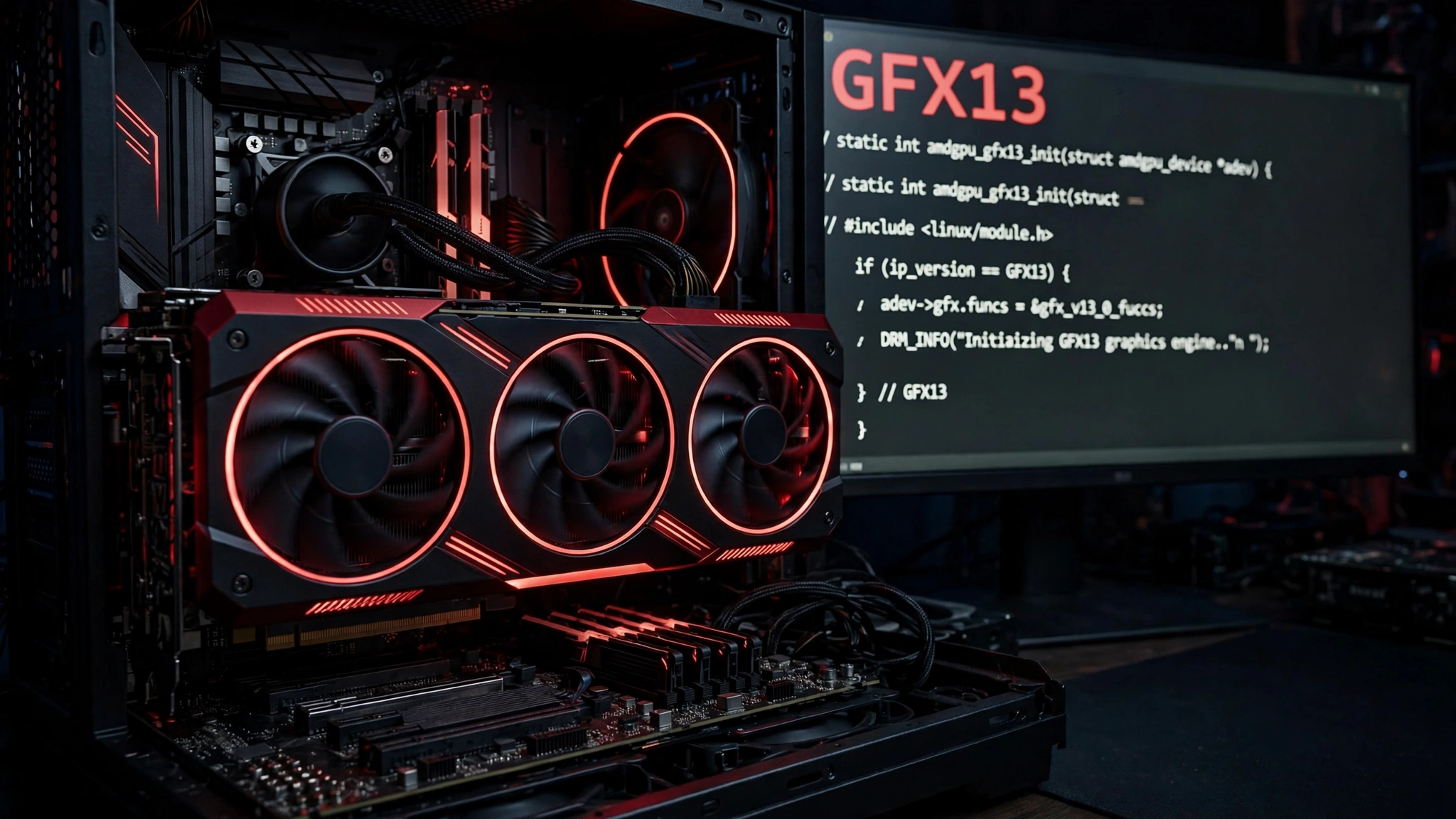
AMD has taken another concrete step toward its next generation of Radeon graphics cards. The company submitted a fresh batch of Linux kernel patches on November 9 that add foundational support for GFX13, the graphics core widely believed to power RDNA 5 GPUs. The patch series adds 12,643 lines of code across 32 files, and it is the clearest sign yet that RDNA 5 is moving from rumor to real hardware enablement.
This is not a launch, and it is not a specs leak. No graphics card was announced, no performance figure was published, and AMD has still not confirmed that GFX13 will be sold as RDNA 5. What the patches do show is that AMD is building the software stack for its next architecture early, and that work is now reaching the actual graphics engine rather than the supporting blocks around it.
What the GFX13 patches actually add
AMDGPU maintainer Alex Deucher submitted the eight-patch series on November 9, and Phoronix spotted it first. The patches go well beyond adding a hardware ID. They introduce the GFX13 graphics engine driver plus new implementations for the Micro Engine Scheduler (MES), the Integrated Management Unit (IMU), and parts of the Kernel Fusion Driver (KFD), which handles GPU compute workloads.
| Patch detail | What it is |
|---|---|
Patches submitted | 8 patches, November 9, 2026, by AMDGPU maintainer Alex Deucher |
Lines of code | 12,643 lines added across 32 files, with 15 deletions |
Graphics IP targets | GFX 13.0.1 and GFX 13.0.4 |
New components | GFX13 graphics engine driver, MES, IMU, KFD compute parts |
Also included | Compute-wave save-and-restore trap handler, graphics clock gating |
Still missing | Per-queue resets in MES, disabled for now until further work |
Possible kernel | Linux kernel 7.5, per Phoronix, not confirmed |
The changes also enable several graphics clock gating mechanisms, which lay the groundwork for hardware scheduling, compute support, and power management. One patch makes the early state of the work plain: the GFX13 MES implementation does not yet support per-queue resets, so that feature is disabled until further development lands. This is normal for bring-up code, but it underlines that the driver is still a work in progress.
Two GFX13 targets point to more than one configuration
The patches introduce support for two GFX13 graphics IP targets, GFX 13.0.1 and GFX 13.0.4. Their existence suggests AMD is preparing multiple hardware configurations, although the identifiers do not necessarily correspond to two separate retail GPUs. Different targets can cover different silicon revisions, product tiers, or internal variants that never reach store shelves on their own.
That is worth keeping in mind before anyone starts guessing model names. The patches offer no GPU model names at all, and no confirmed Compute Unit counts, clock speeds, memory configurations, or performance figures. The code tells us AMD is building for GFX13. It does not tell us what the finished cards will be called or how fast they will run.
Why everyone reads GFX13 as RDNA 5
The link between GFX13 and RDNA 5 is an inference, but it is a well grounded one. GFX12 was the graphics IP behind RDNA 4, the architecture in AMD’s current RX 9000 series cards. A new GFX13 generation following the same naming pattern points at the next architecture, and the wider reporting consensus is that this is RDNA 5.
AMD has yet to officially confirm that GFX13 will be marketed as RDNA 5, much less announce a commercial launch date. The company has also said little in public about the architecture itself, beyond the expectation that RDNA 5 will use a significantly different design from previous AMD GPUs. That is one more reason the driver work is starting early: a bigger architectural change needs more lead time in software.
The road to RDNA 5 so far
The GFX13 patches are the latest step in a sequence of public enablement work that has been building through 2026. Each step covered a different part of the software stack, and together they show a methodical ramp rather than a single leak.
| When | Milestone |
|---|---|
| January 2026 | Initial GFX13 support appears in the LLVM compiler, the groundwork for building software for the new architecture |
| August 2026 | Display Core Next 6 (DCN6), the display engine associated with GFX13 hardware, shows up in driver work |
| September 2026 | GDDR7 related kernel patches appear, suggesting AMD is preparing its driver stack for newer graphics memory |
| November 9, 2026 | GFX13 graphics engine driver lands in an eight-patch series, with MES, IMU, and KFD compute support |
With the compiler, the display engine, memory related components, and now the graphics core all receiving attention, the next generation Radeon hardware is steadily progressing through software enablement. Nothing here is a product announcement. It is the public trail of a chip being prepared, and it is the kind of trail that only becomes visible when a launch is far enough along to need real driver code.
When could RDNA 5 graphics cards actually launch
Do not expect RDNA 5 at CES 2027. Well known leaker Kepler_l2 said about a month ago that RDNA 5 should not be expected any time soon, and that a launch should not be expected until Computex 2027 or late 2027 at the earliest. That matches the current reporting, which puts the first RDNA 5 based products in the second half of 2027, potentially starting with a mid-range AT2 GPU, while the rest of the next generation Radeon lineup could slip into 2028.
Those dates are rumors, not AMD statements, and they can move. The kernel patches could make their way into Linux kernel 7.5, according to Phoronix, although their inclusion has not been confirmed. A kernel landing would be another milestone, not a launch signal on its own. AMD typically enables new hardware in Linux months ahead of retail availability, and the gap between first patches and shipping products is often long.
What this means for PC builders right now
For anyone building or upgrading a PC today, the practical message is simple: RDNA 5 is coming, but it is not close enough to wait for.
- RDNA 4 is still the current generation. The RX 9000 series remains what AMD is actually selling, and it recently outsold NVIDIA on Amazon US in October 2026, led by the RX 9070 XT. If you need a card now, the current lineup is the real choice. Read our breakdown of AMD beating NVIDIA in October GPU sales on Amazon US to see how the current generation is selling.
- Software tricks are filling the gap meanwhile. Modders are already bringing new rendering tech to current Radeon cards. The AMDLSS5 2.0 mod, for example, brings DLSS 5 neural rendering to Radeon GPUs, with its developer claiming a 64 percent FPS jump in one test scene. See our coverage of AMDLSS5 2.0 bringing DLSS 5 neural rendering to Radeon GPUs for the caveats behind that claim.
- Watch the kernel, not the rumor mill. Further GFX13 patches, developer kit sightings, and Linux kernel merges are the reliable signals. Each one narrows the launch window a little more.
- Expect AMD to stay data center first. CEO Lisa Su said last week that AMD is a data center-first company, and GPU makers are prioritizing data centers in 2026. Gaming cards are still coming, but they are no longer the first call on new silicon.
- The competition is not standing still either. NVIDIA has confirmed its RTX 5090 is not discontinued, with GB202 allocations staying active for board partners. Read our report on NVIDIA confirming the RTX 5090 is not discontinued for the other side of the high end market.
None of this changes what to buy this week. It does tell us the next round of the GPU race is already being built in public, one kernel patch at a time.
What the patches do not tell us yet
It is worth being clear about the limits of this news. The patches offer little concrete information about what RDNA 5 can actually do. There are no confirmed Compute Unit or Workgroup Processor counts, no clock speeds, no memory configurations, no performance figures, and no GPU model names. The two GFX13 targets do not map to retail products on their own, and the missing per-queue reset support shows the driver is still early.
That is the honest shape of the story. AMD is preparing RDNA 5 in the open, through its Linux driver, months before any launch. The code is real, the timeline is still a rumor, and the performance is still unknown. The next reliable update will be the next batch of patches, and we will cover it when it lands.
Sources: Wccftech, The FPS Review (original report via Phoronix).