RTX 5080 24GB January Launch in Doubt as NVIDIA Holds Back Board Partner Kits
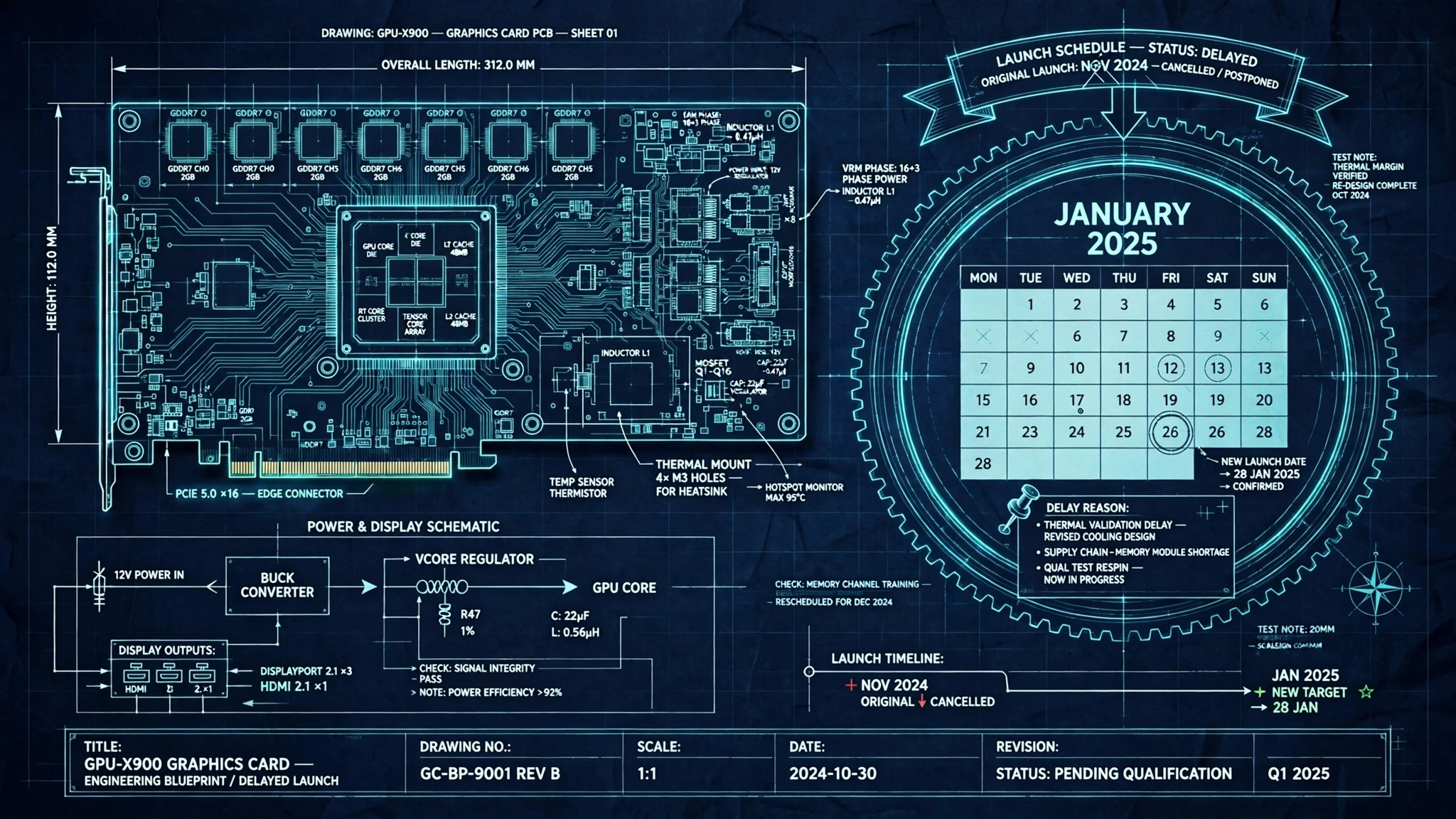
NVIDIA’s board partners are running out of time. According to a new report from The FPS Review, citing BenchLife via VideoCardz, the company still has not delivered the design kits partners need to build a 24GB version of the RTX 5080. With each passing week, a January 2027 launch looks harder to hit.
If you have been searching for news about the RTX 5080 24GB, you probably have the same five questions: does this card actually exist, when is it coming, why is it delayed, what would 24GB change for gaming and creating, and should you wait for it or buy something now? This guide answers all of them.
Does the RTX 5080 24GB actually exist?
Short answer: not as a product you can buy. NVIDIA has never announced a 24GB RTX 5080. What exists is a long trail of rumors, and now a credible report explaining why the card is stuck.
A 24GB variant of the RTX 5080 has been rumored for almost as long as the 16GB card has existed. The rumor has refused to die because it makes technical sense: the memory configuration is straightforward, the silicon already supports it, and there is real demand from gamers and creators who find 16GB limiting. But a rumor is not a product, and until NVIDIA says the words, the 24GB 5080 remains unconfirmed.
What VRAM actually does, and why more of it helps
VRAM is your graphics card’s private memory. It holds everything the GPU needs close at hand: textures, frame buffers, geometry data, shaders, and the working data for ray tracing. When a game scene loads, its assets stream into VRAM so the GPU can grab them instantly.
When VRAM runs out, two bad things happen. Either the game starts swapping data to your much slower system RAM, which shows up as stuttering and hitching, or the game quietly drops texture quality to fit. You may have seen this as blurry textures that take a second to sharpen, or texture pop-in as you turn the camera.
How much VRAM you need depends on what you do:
- Resolution: higher resolutions need bigger frame buffers. 4K uses far more VRAM than 1440p for the same scene.
- Texture quality: ultra and high-resolution texture packs are the single biggest VRAM consumers in modern games.
- Ray tracing: ray traced lighting, reflections, and shadows add their own memory overhead on top of everything else.
- Modding: high-resolution texture mods and reshade-style tools push VRAM use well past what the base game needs.
None of this means more VRAM automatically makes a card faster. VRAM is a ceiling, not an engine. If your games never touch 16GB, then 24GB changes nothing. The value of extra VRAM shows up only when you would otherwise hit the ceiling.
16GB vs 24GB: what changes for you
For most 1440p gaming, the 16GB on the current RTX 5080 is fine. The pressure for more VRAM comes from specific situations:
- 4K gaming with maxed-out textures: this is where 16GB cards start to feel tight. Ultra texture packs at 4K, especially with ray tracing enabled, are exactly the workload where extra headroom matters.
- Creators: video editors working with high-resolution timelines, 3D artists rendering in tools like Blender, and anyone doing GPU-accelerated compositing all benefit from larger VRAM pools. Scenes that spill out of VRAM render dramatically slower.
- Local AI workloads: running large language models or image generation locally loads the entire model into VRAM. Bigger models simply do not fit in smaller cards, so 24GB opens doors that 16GB keeps shut.
- Future-proofing: games keep getting heavier. Buyers who keep a card for three or four years often prefer to buy headroom now rather than hit a wall later. Nobody wants to think about VRAM ceilings for the next three years.
NVIDIA knows this segment exists, and the continued rumors suggest the company keeps coming back to the idea. The problem is not demand. It is supply and timing.
Why the 24GB card was supposed to happen
The early theory behind the 24GB rumor was about memory economics. A 24GB card on the RTX 5080’s memory bus needs 3GB GDDR7 modules, eight of them to be exact. The idea was that NVIDIA was waiting for 3GB GDDR7 module prices to fall far enough to make a 24GB card viable at a sensible price.
That bet has not paid off. Memory prices have moved in the opposite direction, with manufacturers prioritizing AI contracts over consumer GPU memory. Data center demand for high-bandwidth memory is enormous right now, and memory makers follow the money. That makes the economics of a 24GB 5080 arguably worse today than they were a few months ago.
The design kit problem
The design kit detail is what gives this report its teeth. Here is how GPU launches normally work: NVIDIA designs the reference card, then sends board partners design kits containing the key components, including the memory modules that NVIDIA sources through its Samsung and TSMC supply deals. Partners buy those modules from NVIDIA and build their custom PCBs, coolers, and factory overclocks around them.
Without design kits, board partners cannot start serious engineering work. The timeline looks like this:
- Past launches: roughly six weeks from design kits landing with partners to retail availability.
- This time: reportedly about eight weeks, partly because NVIDIA’s focus is on AI contracts.
Do the math from early November and the January window looks very tight indeed.
From the board partners’ perspective, the wait is its own problem. Custom cards take real engineering time, and every week without design kits is a week that cannot be recovered. Partners plan production lines, cooler designs, and marketing around launch windows. A compressed timeline does not just risk a missed January date. It risks a thin, paper-launch-style release with little stock, which is the last thing a premium card needs.
The 24GB silicon already exists
There is an interesting data point hiding in plain sight: the mobile RTX 5090. In its MXM format, it is effectively a 24GB GB203 part, with up to 175W of power budget, slightly fewer cores, the same die shared with the desktop RTX 5080 and 5070 Ti, and 24GB of GDDR7 memory. In other words, a 24GB configuration on this silicon already exists. It is just not on the desktop yet.
This matters because it removes one possible excuse. The memory controller and the die clearly handle 24GB fine. Whatever is holding the desktop card back, it is not the silicon. It is the business side: memory pricing, supply allocation, and launch timing.
What the rumors say now
Rumors have not stopped at the delay itself. Some reports still point to a possible unveil at CES 2027, and there is talk of the card arriving under a SUPER refresh banner rather than as a standalone launch. Neither has been confirmed by NVIDIA, and both should be treated as rumor for now.
The SUPER angle is worth understanding. NVIDIA has a history of mid-generation refreshes that slot improved models into the lineup, and a 24GB 5080 would fit that pattern neatly. But a pattern is not a promise. Until NVIDIA announces something, every scenario below is speculation.
What if…
…NVIDIA makes the RTX 5080 24GB a Founders Edition-only release? This is pure speculation, so take it as a thought experiment rather than a prediction.
Founders Edition cards are sold at MSRP, which puts direct pressure on board partners who need margin on their custom designs. A limited FE-only release would let NVIDIA test the waters on a 24GB card without committing partners to a full product stack, and it could be a time-limited run depending on how memory supply shakes out.
To be clear, no report has claimed this will happen. It is a scenario, not a leak. But it is worth keeping in mind, because if the card does appear in limited form, the buying experience could look very different from a normal launch: fewer models, tighter stock, and less room to shop around.
Should you wait or buy now?
This is the question that actually matters, so here is the honest breakdown.
Wait for the 24GB card if: you game at 4K with ultra textures and ray tracing, you do creative work or local AI workloads that need the VRAM, or you keep cards for years and want the headroom. Just understand the wait is getting longer and less certain, and there is no confirmed launch date.
Buy now if: you game at 1440p, where 16GB is comfortable, or you simply need a card today. The current 16GB RTX 5080 and its rivals are the cards you can actually buy, and our RTX 5060 vs RX 9060 XT benchmarks show where the current midrange battle lines sit.
Before you spend anything: check whether your current card is even being held back by the rest of your system. A GPU upgrade does nothing if your CPU is the bottleneck, and our guide on low GPU usage and CPU bottlenecks walks through how to tell.
The bottom line: the RTX 5080 24GB is a real rumor with real technical logic behind it, but the business reality keeps pushing it further out. Do not plan a build around a card that has no announcement date. Buy for what exists today, and treat the 24GB card as a pleasant surprise if it ever arrives.