Why SSD Prices Will Stay High for Years: The HBF Wafer Problem
Cheap SSDs Will Have to Wait
There is a new reason to stop holding out for SSD prices to fall. A new memory technology called High Bandwidth Flash, or HBF, could squeeze NAND wafer supply for years once it goes commercial, and that squeeze lands directly on the price of the SSD in your next PC, according to a new report by Wccftech.
Reported November 3, 2026, the analysis puts a hard number on the problem. HBF looks like a breakthrough on cost per gigabyte, but its appetite for silicon wafers is ferocious. The result is that the very technology that makes high-bandwidth memory cheaper for AI data centers could make consumer storage more expensive for everyone else.
If you have been waiting for the right moment to buy an SSD, this article covers the full picture: why prices are already high, what the HBF wafer problem is, how long the pressure is likely to last, and what you should actually do about it.
Why SSD Prices Are Already High
The HBF story does not start from a healthy market. Memory and storage prices have been climbing for a while, and the pressure is coming from the same direction: AI data centers are consuming enormous amounts of memory, and fabs are steering their limited capacity toward the products with the fattest margins.
That shift has visible consequences for PC builders. Soaring component prices have pushed GPUs and memory kits far above their launch prices, and storage has not been spared. Our RTX 5090 price hike breakdown shows how memory-driven inflation has hit graphics cards too. When the most profitable thing a fab can make is high-margin memory for AI accelerators, consumer NAND gets whatever capacity is left over.
This is not a new pattern. The memory industry has swung between oversupply and shortage for decades, and the shortage phase rarely ends quickly because new fab capacity takes years to come online.
How SSD Pricing Actually Works
To understand why a wafer problem in AI memory affects your SSD, it helps to know how an SSD gets its price. Almost every SSD starts life as NAND flash memory, which is manufactured on circular silicon wafers inside giant fabrication plants.
- Wafers are the raw material. Each wafer is etched with NAND dies, cut apart, packaged, and assembled into SSDs. A fab can only process a fixed number of wafers per month.
- Capacity is shared across products. The same NAND wafer supply feeds consumer SSDs, enterprise drives, phones, and now potentially HBF stacks for AI.
- Margins decide who gets wafers. When several products compete for the same limited wafer supply, the products with the highest margins get priority. Consumer SSDs rarely win that contest against AI hardware.
- Prices follow supply, with a lag. Contract prices between NAND makers and SSD brands move first, and retail prices follow weeks or months later.
NAND and DRAM are different technologies, but they share the same dynamic: fixed fab capacity and demand that can spike far faster than supply can respond.
What Is High Bandwidth Flash?
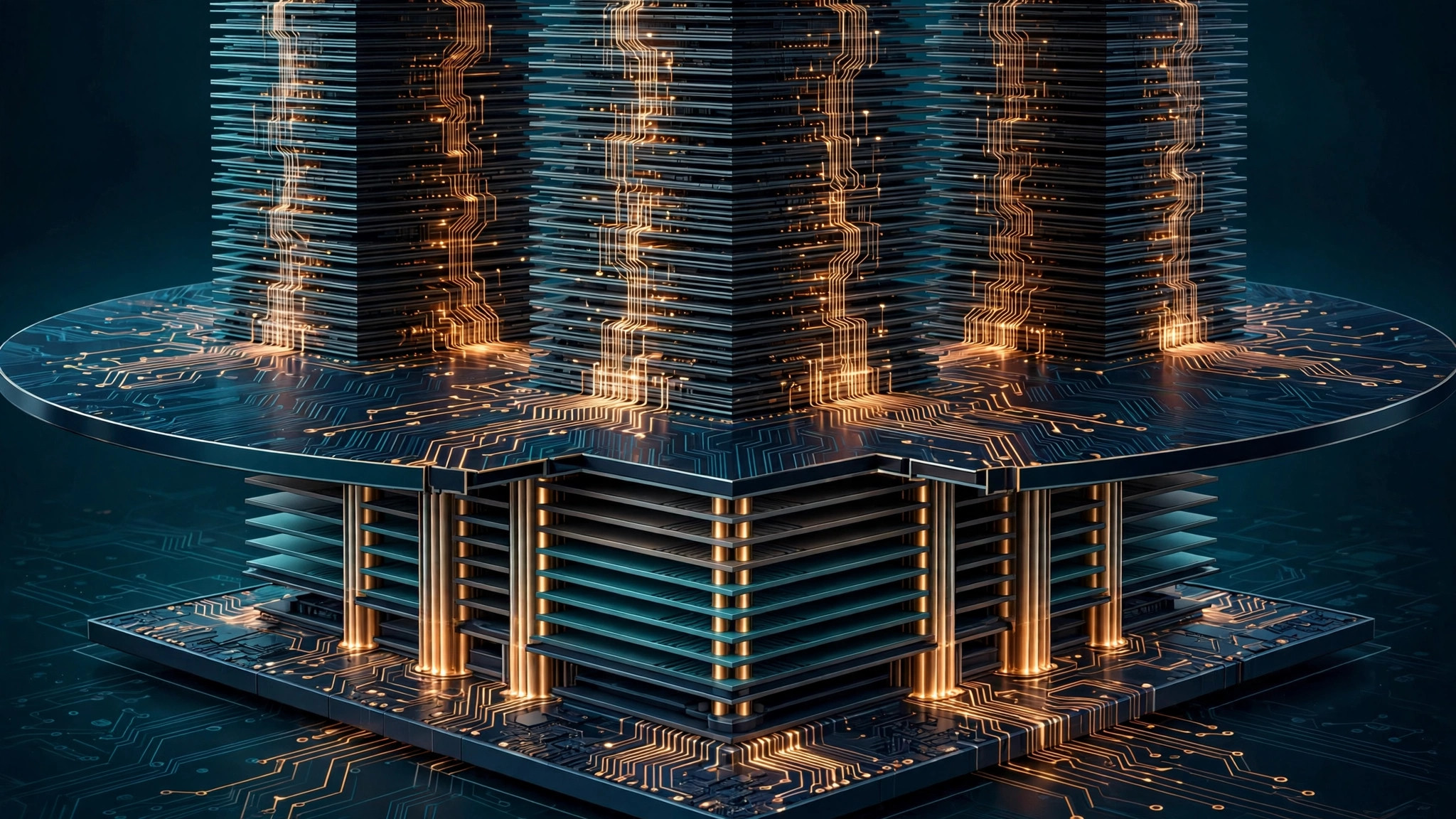
HBF is a simple idea built on a hard problem. Just as HBM stacks DRAM dies, HBF stacks NAND dies on top of each other, with Through Silicon Vias (TSVs) connecting the dies together and a controller logic die bonded to the NAND array, Wccftech explains.
The hard problem is that NAND is slow. An SRAM read takes around a nanosecond, DRAM takes around 100 nanoseconds, and NAND takes around 100 microseconds, Wccftech notes. That makes NAND reads roughly 1,000x slower than DRAM-based HBM.
HBF gets around this with brute-force parallelism. The logic die schedules thousands of simultaneous NAND reads, pushing combined bandwidth to 0.3 TB/s to 3 TB/s, Wccftech reports.
There are real limits. Wccftech points out that HBF cannot fix NAND’s poor write speeds or fragile write endurance. But for read-heavy workloads it is extremely attractive, which is why SanDisk is developing an HBF standard with SK hynix: 512GB of capacity at 0.4 TB/s to 3 TB/s, with commercial rollout expected in 2028 or 2029.
The $0.64 per GB Figure That Changes Everything
Here is where the economics get dramatic. Analysts at Bernstein estimate that a typical 8-Hi HBF stack will cost just $0.64 per GB, Wccftech reports. That is roughly one-tenth the $6.78 per GB cost of a comparable 8-Hi HBM4 stack.
At that price gap, HBF can credibly displace HBM in several AI workloads. Wccftech names two: storing model weights, and shared-prefix KV caching, where thousands of user prompts query the same massive system prompt or codebase and the cache for that shared data is computed once and written permanently to HBF.
This is the Jevons paradox at work: cheaper bandwidth means more demand, not less. Data centers will buy far more of it, not the same amount for less money, which is more wafers consumed, not fewer.
The 6.5x Wafer Appetite Is the Bad News for SSD Buyers
The catch is manufacturing. Wccftech reports that each 8-Hi HBF stack uses 6.5x more wafers than a typical TLC NAND wafer run. Once HBF enters its commercial phase, it will consume a large share of available NAND wafer supply.
That supply squeeze is what precludes cheaper SSDs. The fabs cannot print unlimited wafers. Every wafer that goes into HBF stacks for AI data centers is a wafer that does not become consumer TLC NAND for your next SSD, and that lost supply flows straight into retail prices.
The industry cannot simply build its way out. A new NAND fab takes years to construct and costs billions, and every wafer from existing fabs goes to its most profitable use. A 6.5x wafer multiplier on a product aimed at the highest-margin customers means consumer SSDs move down the priority list, not up.
The timing makes it worse. The memory market is already under heavy pressure, with soaring component prices pushing GPUs and memory kits far above their launch prices, and HBF would add a large new consumer of NAND wafers on top.
How Long Will Prices Stay High?
No one can put a firm end date on a memory price cycle, and you should distrust anyone who does. But the shape of the timeline is visible in the facts Wccftech reports.
- The pressure is already here. Component prices across GPUs and memory kits are far above launch levels today, in November 2026.
- HBF goes commercial in 2028 or 2029. That is when the 6.5x wafer appetite starts biting in earnest, according to the SanDisk and SK hynix development timeline Wccftech cites.
- Relief needs new supply or cooling demand. Until NAND fab capacity grows faster than HBF and AI demand, the structural pressure points upward, not downward.
The realistic read is that there is no catalyst for cheaper SSDs on the horizon. The current tightness has no scheduled end, and the next major demand driver, HBF, arrives in 2028 or 2029 and makes the wafer math worse. Short dips and promotional pricing will still happen, but a return to the cheap-SSD era would require either a demand collapse or a large supply expansion, and neither is visible right now.
What This Means for Your Next SSD Purchase
The practical takeaway is simple. Do not plan your next PC build around the assumption that storage will get cheaper.
- Buy storage at fair prices when you see them. Waiting for a market crash that the supply data does not support is a losing strategy.
- Budget storage early. If you are speccing a build now, lock in your SSD choice early rather than treating it as the part you will grab last. Our budget gaming PC build guide is built for exactly this market, where every part has to earn its place in the budget.
- Size your drive for the long haul. If prices stay elevated, you want enough capacity today that you are not forced to buy a second drive at worse prices later. Games keep getting bigger, and a cramped drive fills up faster than you expect.
- Do not overpay for speed you will not feel. In a tight market, the smart money goes to capacity and reliability first. For gaming and everyday use, a solid midrange drive with enough space beats a flagship drive that is half the size.
- Watch for real deals, not the old normal. Judge a price against today’s market, not against what SSDs cost two years ago. A fair price now can still be a good buy even if it looks high by historical standards.
The Verdict: Buy Now or Wait?
HBF is genuinely exciting technology. Bandwidth of 3 TB/s at one-tenth the cost of HBM4 could reshape AI data centers. But the bill for that progress gets passed down the supply chain, and it lands on the same NAND wafers your SSD is made from.
So, buy now or wait? The answer is buy now, with two qualifications. First, buy at a fair current-market price, not at a panic premium; track prices for a week or two so you know what fair looks like. Second, buy the capacity you will need for the next few years, because the market gives you no reason to expect a better deal later.
Until NAND supply grows faster than HBF demand, cheap SSDs are not coming back. Buy the storage you need now, at prices you can live with, and plan the rest of your build around a market that stays tight.
News Source: Wccftech